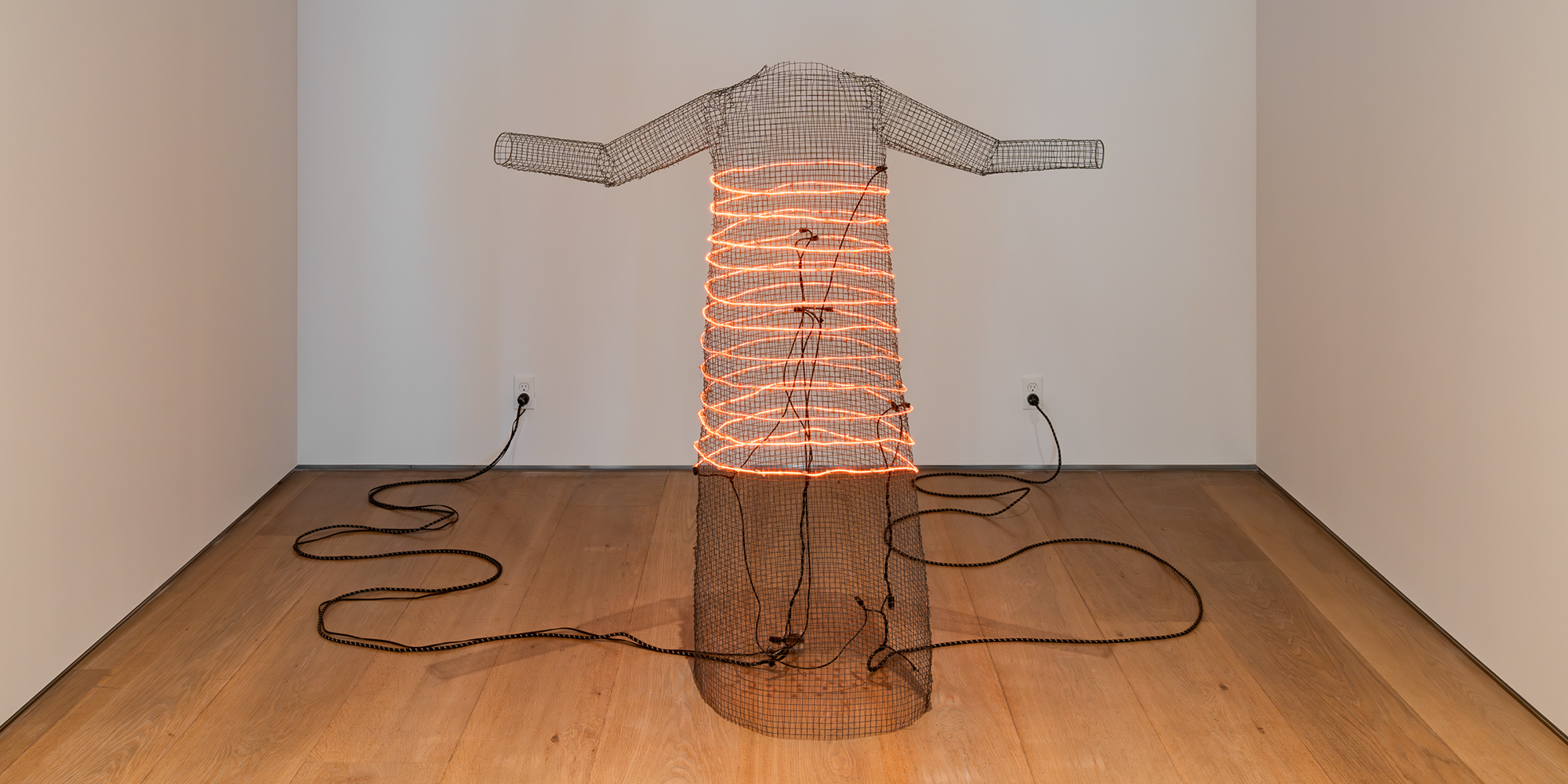
 Jana Sterbak, I Want You to Feel the Way I Do... (The Dress), 1984-85.
Live uninsulated nickel-chrome wire mounted on wire mesh, electrical cord and power, with text.
National Gallery of Canada, Ottawa. Purchased 1986. Photo by Blaine Campbell.
Jana Sterbak, I Want You to Feel the Way I Do... (The Dress), 1984-85.
Live uninsulated nickel-chrome wire mounted on wire mesh, electrical cord and power, with text.
National Gallery of Canada, Ottawa. Purchased 1986. Photo by Blaine Campbell.Dimensions of Intimacy
A response to Jana Sterbak
There is a quality of lore around Jana Sterbak. Alongside her pyrotechnic affinities and notoriously difficult materials, she remains an artist associated with burning crowns, evaporating ice, chocolate bones, wire cages, and dresses stitched from raw flank steak. For decades, her work has hovered between seduction and recoil: she invites viewers close through sensory appeal, only to confront them with instability, mortality, exposure, or discomfort. The body, in Sterbak’s work, is never stable ground. It is a site of fantasy and discipline, spectacle and decay. It contains and then leaks.
Now, with recent exhibitions in Montreal1 and Calgary, Sterbak’s work has returned to public view with unusual breadth, giving us a chance to reconsider an artist whose influence has become strangely diffuse. Because while Sterbak has been visible everywhere in contemporary art’s fascination with abjection, performative sculpture, bodily vulnerability, and unstable materiality, she has been under-acknowledged directly. Younger artists routinely work with perishability, endurance, theatricality, or flesh-like substances in ways that echo Sterbak’s strategies, but her practice still resists easy assimilation into dominant art-historical narratives. It remains unruly and even now, difficult to domesticate.
Born in Prague in 1955 and later based in Paris and Montreal, Sterbak came of age under conditions that sharpened her sensitivity to systems of authority and containment. A few years after a ripple-inducing exhibition at Toronto’s Mercer Union in 1982, Sterbak began showing on both sides of the Atlantic. Asserting what curator and writer Jessica Bradley calls “expressionist materiality,” Sterbak proposed a practice that positioned her as a restless descendant of artists like Meret Oppenheim, Louise Bourgeois, and Eva Hesse. Her brilliant and at times controversy-flaring arc culminated in a survey at the National Gallery of Canada in 1991, which featured her iconic “meat dress,” Vanitas: Flesh Dress for an Albino Anorectic (1987). Composed of sixty pounds of stitched flank steak, the piece inspired a media storm. A decade later, in 2003, Sterbak represented Canada at the 50th Venice Biennale.
Tensed across her practice—and still now, in newfound ways—is a tautly held wire between autonomy and control. Expressed through the private body and public power, Sterbak developed a visual language that merged sculpture, performance, engineering, costume, and conceptual art. Many of her works appear as prosthetic devices or speculative tools: chairs that dissolve, metal exoskeletons that constrain movement, garments that transform the wearer into a symbolic figure.
Yet unlike the cool industrial vocabularies of her peers’ conceptualist or appropriation-leaning practices, Sterbak’s work has always remained insistently visceral. Even at its most cerebral, her work anchors us in sensation. Heat, smell, gravity, sweat, friction, weight, and time are all active elements, and viewers are made to feel the ideas at play.

To that end, many of Sterbak’s works carry the visual logic of institutional apparatuses—objects that appear to regulate, discipline, or ceremonialize bodily experience. This includes Absorption (a work in progress) (1995), a body-size canvas bag lying prone on the floor, unzipped to reveal a figure wrapped in paper. Cocooned in its own mythology, the work represents the entrails of Sterbak’s effort to become a moth. She chose to metamorphose so that she might devour each of the one hundred editions of Joseph Beuys’s iconic felt suits. It’s an encasing that only reveals another blockage. Read alongside Remote Control II, where one work externalizes control through exposure and choreography, the other folds inward, hoarding its performance as rumor and promise.
Further reinforcing a strength in her sculptural practice of setting the performance—or the imagined act—ablaze in the viewer’s mind is Artist as Combustible (1987), a nearby video featuring a naked young woman being lit like a human candle (the artist herself makes the ignition). On a loop, the flame in her hair flares and dies quickly, leaving us trying to catch its lingering nimbus, its ambient glow.
Sterbak’s sculptures and installations are often remembered first for their materials, but the materials usher us into vehicles for larger philosophical questions. What does it mean to inhabit a body under systems of pressure? How can we move? What holds us back? What becomes possible, given where we’re coming from and where we are? She addresses these questions almost ruefully—not by offering answers but by staging conditions, so that the question becomes: how do technologies, institutions, political structures, and fantasies regulate physical experience? What forms of intimacy emerge between bodies and objects? Sterbak’s work repeatedly positions the body as something both intensely personal and structurally conditioned. For instance, in works such as I Want You to Feel the Way I Do… (The Dress) (1984-85), or the various exoskeletal structures that recur throughout her practice, Sterbak choreographs the body through external systems. Movement is shaped, inhibited, and aestheticized.
As an extension of this, Sterbak’s ongoing interest in discipline and ritual means her sculptures often resemble ceremonial devices. A metal cage may appear simultaneously medical and ecclesiastical; a wearable structure may feel both protective and punitive. Throughout Sterbak’s oeuvre, bodily regulation frequently carries a quasi-spiritual dimension.

At Esker Foundation, a 2025 retrospective Dimensions of Intimacy offered a glinting survey of Sterbak’s nearly five-decade career, bringing together over fifty works across sculpture, photography, performance, and video. The exhibition emphasized both the consistency and adaptability of the artist’s concerns around vulnerability, embodiment, technological mediation, and psychic exposure, and showcased how she has approached them through dramatically shifting formal strategies.
In all her variegated media and striated themes, Sterbak remains elusive to categorization. She has often been grouped within feminist art histories, body art, or conceptual sculpture, but no single framework fully contains her practice. And, unlike many artists associated with body art in the 1970s and ‘80s, Sterbak seldom presents her own body directly as the central medium. Instead, she externalizes bodily conditions through objects, architectures, or delegated performances, lending her practice a peculiar psychological intensity. The body is everywhere implied but rarely fully present.
Sterbak’s best-known work remains Vanitas: Flesh Dress for an Albino Anorectic, first created in 1987. Stitched from raw meat and gradually decaying over the course of exhibition, the piece stages fashion, mortality, consumption, desire, femininity, spectacle, and bodily discipline all at once. Dense with symbolism, the work’s longevity also points to a broader misunderstanding of Sterbak’s practice. The dress is frequently reduced to scandal or provocation, despite the conceptual precision that structures it. In reality, Sterbak’s work is less interested in shock than in transformation. The meat changes visibly over time, collapsing distinctions between sculpture and process. The body becomes inseparable from temporality itself.
And then there is the matter of enduring, or aging, or fading. Under Sterbak’s guise, materials melt, rust, burn, decay, evaporate, or shift states, and time is never incidental. Sterbak frequently uses unstable substances that refuse permanence and, instead, insist on entropy.
These works are more quixotic than baleful and return us to Sterbak’s sharp deployment of humor—a quality renewed by these recent exhibitions. Her descriptions of power are underlined by wit and timing, like a prank, a pulled card, a rabbit briefly transfigured before disappearing again. But encountered in the flesh, this humor is inseparable from sensation: heat that flares and recedes, materials that sweat, cure, glow, or withhold themselves just long enough to frustrate our grasp.

Humour helps unseat any type of reading that could frame the work solely through suffering or abjection. Sterbak is acutely aware of spectacle. She understands seduction as both an aesthetic and political mechanism, and many works draw viewers in through beauty, elegance, or curiosity before unsettling them.
It follows that performance has therefore always been central to the work, even when no live body is present. Her sculptures often imply action: they anticipate movement, occupation, activation, or endurance. A chair suggests sitting. A harness suggests wearing. A cage suggests containment. Viewers unconsciously project themselves into these scenarios or a video nearby gives us evidence of its movement.
This performative structure also helps explain the continuing relevance of Sterbak’s work for younger artists. Contemporary sculpture has increasingly embraced theatrical installation, unstable materials, delegated performance, and affective environments. Many of these strategies have clear precedents in Sterbak’s practice.
It’s a practice that remains suspended in contradiction and refuses easy moral framing. Constraint and freedom can coexist just as vulnerability can become a form of agency and seduction can become coercive. The body in Sterbak’s work, neither victim nor sovereign, is contingent: shaped by systems, technologies, histories, fantasies, and environments. All of this informs Sterbak’s unusual staying power, her quality of being forever right on time.
It also makes her difficult to assimilate into contemporary institutional narratives, which often prefer clarity of position. Sterbak’s work does not deliver stable ideological reassurances. The work remains psychologically unresolved.
This becomes especially compelling in relation to contemporary anxieties surrounding technological mediation and bodily optimization. Although much of Sterbak’s work predates current conversations around surveillance, biometric tracking, and algorithmic self-management, her sculptures often seem prophetic in retrospect. Many resemble prototype devices for regulating emotion, movement, or physical behavior.
At the same time, her work remains profoundly tactile. Unlike much technologically oriented contemporary art, Sterbak never abandons materiality. Flesh, metal, cloth, wire, hair, water, fire, and ice all retain symbolic and sensory weight. Sterbak insists that embodiment cannot be fully abstracted. And where contemporary life increasingly encourages forms of disembodiment—remote communication, virtual identity, optimized self-presentation, quantified wellness—Sterbak counters these tendencies by emphasizing physical vulnerability and sensory immediacy. Her work repeatedly returns viewers to the fact of having a body. And then asks us to go further, still, as bodies are not sites in and of themselves; they are unstable assemblages shaped by power and fantasy, discipline and labor, and perhaps most of all, desire.
That tension between intimacy and alienation animated much of the Esker retrospective’s emotional force and its title, Dimensions of Intimacy, captured an essential tenet of Sterbak’s practice: that intimacy is much more than closeness, and often emerges through discomfort, exposure, or confrontation instead. One senses this especially in her wearable sculptures. These pieces transform the body into an object of display while restricting it; the wearer becomes both empowered and constrained.

Sterbak’s practice remains deserving of—even requiring—multiple visits: a piece encountered in a museum of medical history resonates differently than it does within a contemporary art foundation; a work viewed in the 1990s acquires new implications in the 2020s. And questions that have animated her practice for decades—bodily governance, technological mediation, performative identity, instability, endurance—now permeate everyday life.
So, the quality of lore around Jana Sterbak—helped as it is by temperamental performances and pyrotechnic affinities, burning crowns, interred sweat, flank steak, etc.—endures, too, for its beckonings that become feints. Sterbak pulls in our witness before repelling it, and, through an enduring engagement with the existential questions anchoring so much of what it is to be alive, her push-pull dynamic work on the viewer’s body—and on what the body is willing to believe. Sterbak’s power lingers not as a spectacle but as an aftereffect, then: held in the senses and limited by what we understand to be true.
1 The exhibition Corpus insolite: Jana Sterbak, curated by Johanne Sloan was presented at Musée des Hospitalières from January 29 to August 2, 2025.
Jana Sterbak: Dimensions of Intimacy
View Exhibition »
Jana Sterbak: From Here To There
View Publication »